
For decades, educators and researchers have explored why some people experience discomfort when reading — shimmering text, glare, headaches, or words that appear to move on the page. While these symptoms are often mistakenly linked directly to dyslexia, recent scientific understanding paints a more nuanced picture.
A portion of the population experiences visual stress, a perceptual sensitivity to certain lighting conditions, contrasts, or colour patterns. Although this is not the cause of dyslexia, it can co‑occur with dyslexia and make reading even more difficult for some individuals. [educationa…nce.org.uk]
As the official Australian supplier of LEE Filters, John Barry Sales is uniquely positioned to discuss how controlled lighting and colour filtering can support comfort, reduce harsh contrasts, and create visually optimal environments — not as a medical treatment, but as a practical tool for customising working and learning spaces.
In this post, we explore what visual stress is, what the research says about coloured filters, and how LEE Filters can be used to create gentler lighting environments in classrooms, studios, reading rooms, edit suites and more.
Understanding Visual Stress (and How It Differs from Dyslexia)
Research from neuroscience and vision science has shown that a subset of individuals experience discomfort when viewing certain patterns or lighting conditions — especially dense black text on a bright white background. This is known as visual stress, and it can create symptoms such as distortions, shimmering, glare sensitivity, and eye strain. [educationa…nce.org.uk]
Importantly, visual stress is a perceptual processing issue, not an eye disease, and is separate from dyslexia, though the two can overlap. Studies show that 12–46% of people with dyslexia may also experience visual stress, meaning controlled colour environments can sometimes assist with comfort — even though colours do not treat dyslexia itself. [lensmartonline.com]

This distinction matters for responsible communication:
- Dyslexia = a language processing difference.
- Visual stress = a perceptual sensitivity to high contrast and certain visual stimuli.
What colour filtering can potentially help with is reducing the discomfort associated with visual stress, not remediating dyslexia.
What the Research Says About Coloured Filters
Over the years, researchers have investigated whether colour overlays or filters can help reduce visual discomfort, and results show that:
Some individuals benefit from specific coloured filters-Certain colours can reduce distortions or calm a hyperexcitable response in the visual cortex. [educationa…nce.org.uk]
The helpful colour is highly individual -Studies emphasise that the exact wavelength and tint must be precisely matched; generic coloured sheets offer inconsistent results. [lensmartonline.com]
Blue and green tints show promise in research contexts -Research has found that some children with dyslexia read faster and with fewer fixations using a blue overlay, and other studies show benefits from green overlays. [researchgate.net]
It is not a treatment for dyslexia -Large-scale studies involving thousands of children found no evidence that colour lenses cure or treat dyslexia. [nessy.com]
So where does this leave us?
Colour filters can play a role in improving comfort for sensitive users. And this is where LEE Filters become relevant — not medically, but practically, as a tool for precision colour control.

Creating Visually Comfortable Environments with LEE Filters
While the science is clear that coloured filters do not treat dyslexia, it is equally clear that lighting colour, intensity, and contrast dramatically influence visual comfort.
Because LEE Filters are engineered for accurate, repeatable wavelength control, they allow educators, designers, filmmakers, and technicians to craft environments that reduce glare, soften harsh lighting, and tailor spaces to individual comfort preferences. Here’s how LEE Filters can be used effectively:
1. Reducing glare and harsh contrast
High contrast (e.g., bright LED lighting on white paper) can trigger discomfort for people sensitive to visual stress. Research shows that coloured filters can reduce this by shifting the wavelengths reaching the eye. [lensmartonline.com]
LEE’s range of soft tints — such as pale blues, greens, and warm-toned diffusions — allows you to adjust the harshness of overhead lighting without altering output dramatically.
2. Creating personalised reading or work areas
Because the optimal colour varies from person to person, having access to a broad palette is essential.
Studies emphasise this individualisation: different users require different hues for the best comfort. [lensmartonline.com]
LEE Filter swatches or samplers allow individuals (or educators) to test various colours to determine which feels most comfortable for long reading or screen sessions.
3. Calming high-stimulation environments
Visual stress is linked to a hyperexcitable response in the visual cortex. [educationa…nce.org.uk]
Using soft coloured lighting in classrooms, editing suites, or quiet spaces may reduce overstimulation, creating calmer environments for:
- neurodivergent learners
- individuals prone to migraines
- people sensitive to flicker or glare
Again — this is about comfort, not treatment.
This approach aligns with the “visual comfort” concept supported in research on light, colour, and perceptual load.
The connection between coloured light and visual comfort is real, research‑supported, and practically useful, even though colour is not a cure for dyslexia.
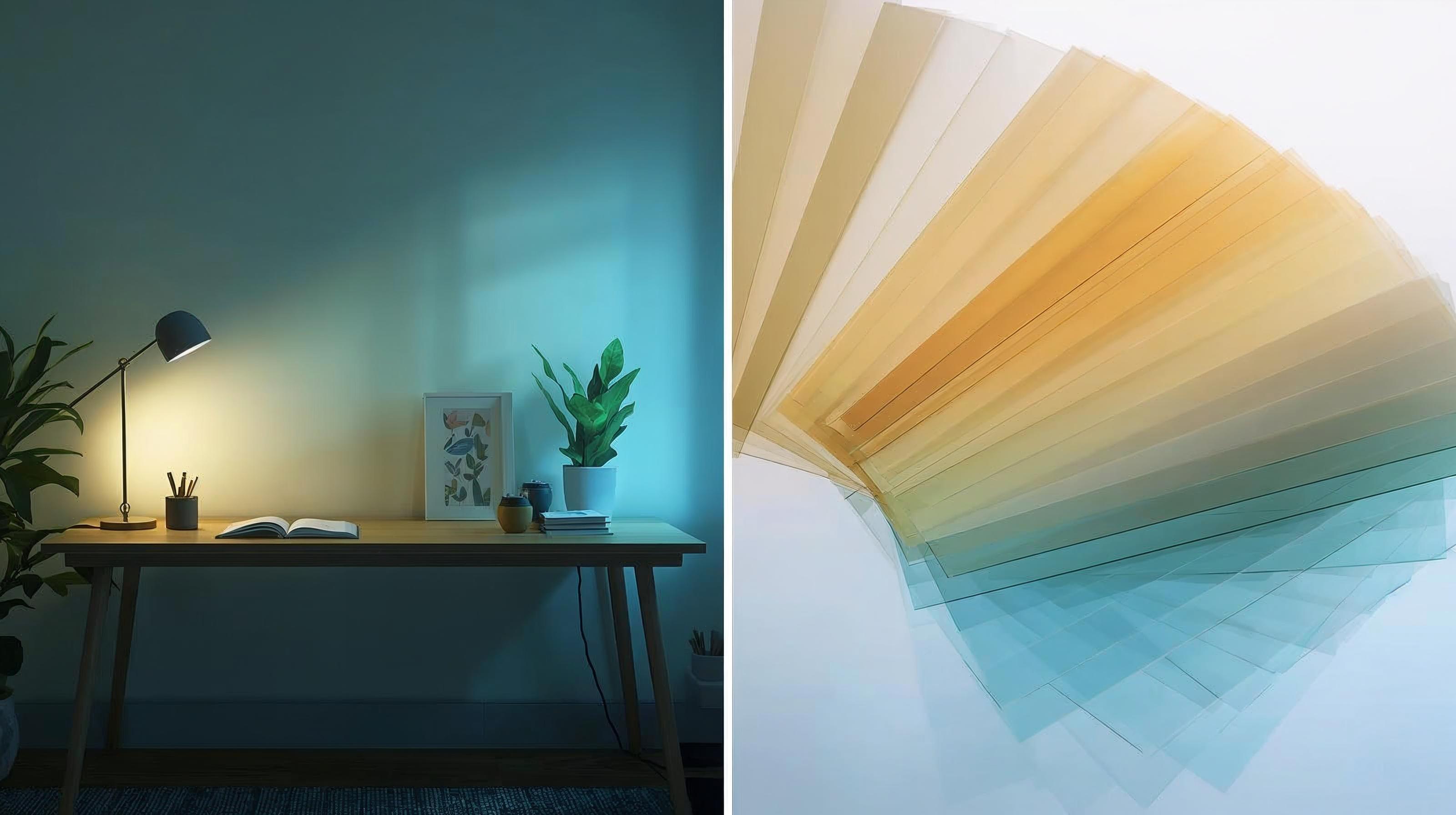
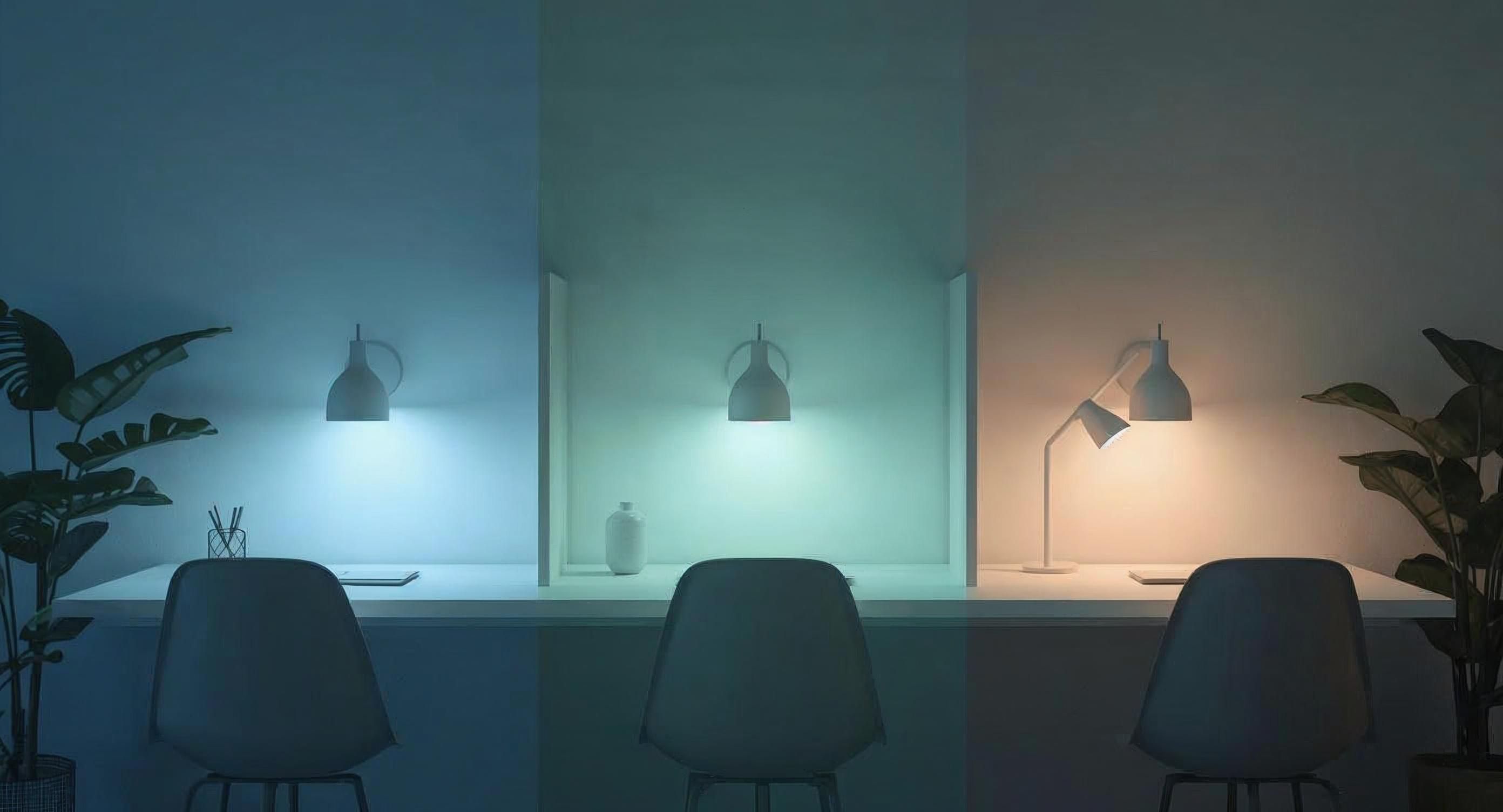
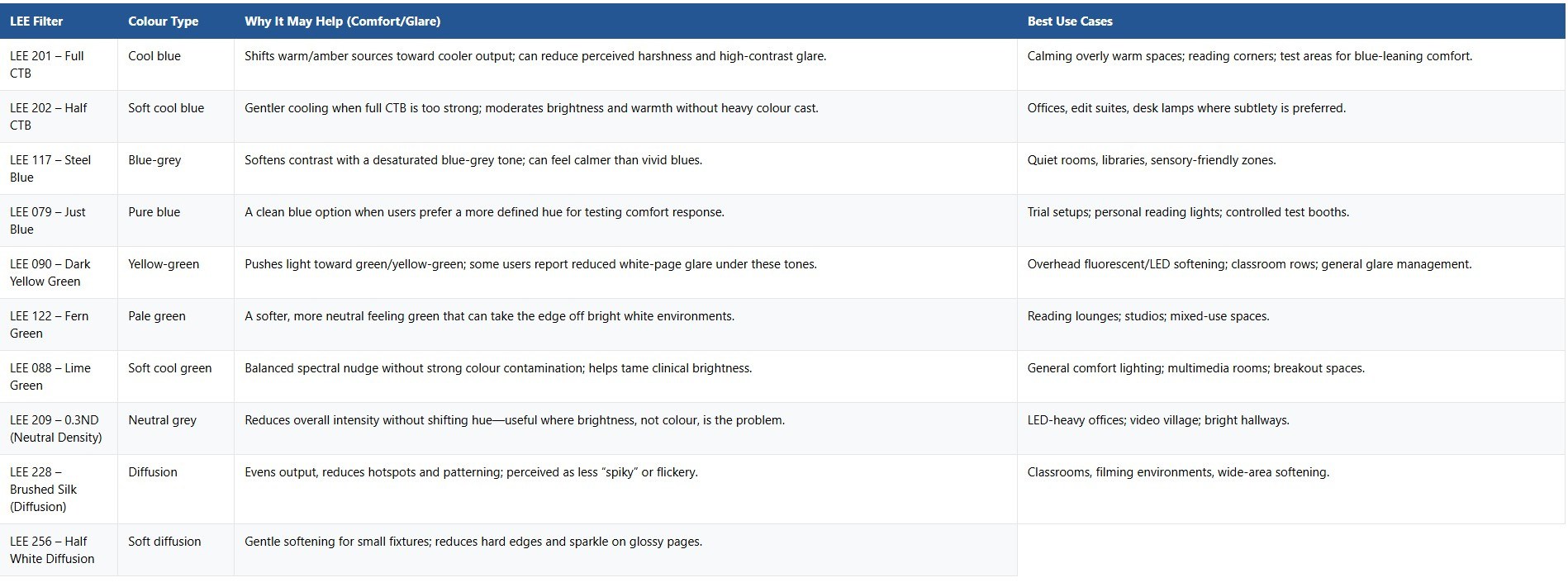
By understanding visual stress and the impact of lighting on perception, we can use tools like LEE Filters to create environments that support comfort, focus, and well‑being — in classrooms, studios, offices, and reading spaces.
And because LEE Filters offer precise, repeatable, controllable colour, they are uniquely suited for:
- experimenting with colour comfort,
- crafting low‑glare lighting setups,
- enhancing usability in learning and creative environments,
- and supporting anyone sensitive to harsh lighting.
In the end, understanding how colour and light influence visual comfort gives educators, creators and workspace designers a simple but powerful tool for improving everyday environments. While coloured filters are not a treatment for dyslexia, research shows that tailored colour and controlled lighting can make a noticeable difference in reducing glare and easing visual discomfort for some individuals.
With LEE Filters offering precise, repeatable colour control across an enormous range of hues and diffusions, it becomes easy to experiment and create calmer, more visually supportive spaces—whether in classrooms, studios, offices or reading areas. For advice on selecting the right LEE Filters for your lighting setup, our team at John Barry Sales is always ready to help with expert guidance and stock availability.